
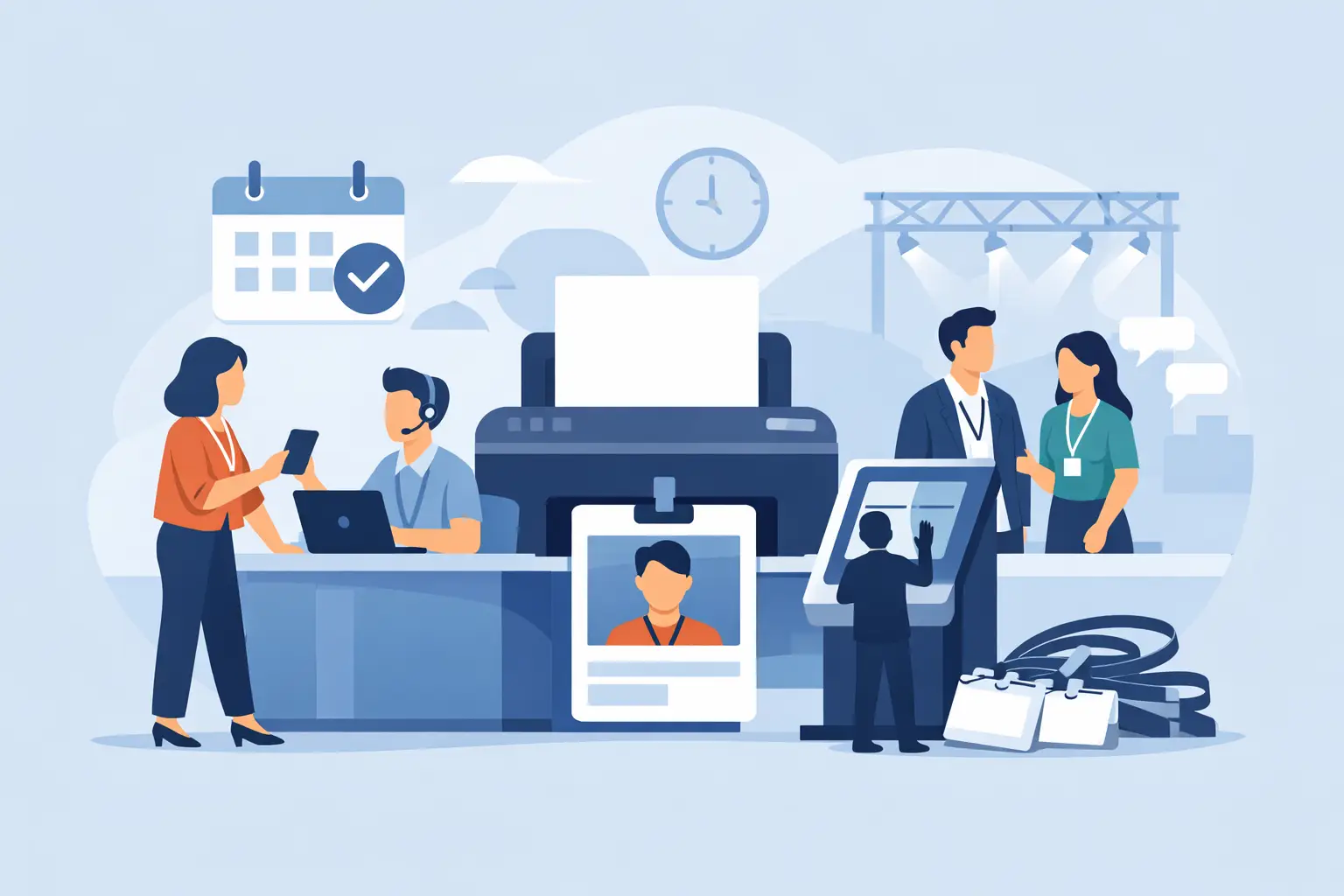
On site badge printing for events speeds check-in, strengthens branding, and reduces friction for organizers, exhibitors, and guests.
The registration desk sets the tone fast. If guests are queuing, searching for names, or waiting while badges are reprinted by hand, the event feels under pressure before it has properly started. That is exactly why on site badge printing for events has become a core part of modern event delivery, especially when timing, branding, and guest flow all matter at once.
For organizers in Dubai, Abu Dhabi, and across the UAE, badge printing is no longer just an admin task. It sits at the intersection of operations, brand presentation, and attendee experience. When it is planned properly, it shortens queues, improves data accuracy, supports VIP handling, and gives staff a live system they can actually work with. When it is treated as an afterthought, small issues multiply quickly on the day.
Why on site badge printing for events matters more than it used to
Guest expectations have changed. People are used to fast digital transactions, personalized experiences, and clear wayfinding. They do not want to arrive at a conference or product launch and wait ten minutes for a paper list to be checked manually.
At the same time, events have become more complex. Organizers are managing pre-registered guests, walk-ins, VIP lists, exhibitors, speakers, media, contractors, and internal teams, often through the same entrance zone. A static badge system struggles in that environment. On-site printing gives you the flexibility to generate the right badge, for the right person, at the right time.
That flexibility matters because not every attendee journey is the same. A pre-approved delegate can move from QR code scan to printed badge in seconds. A walk-in may need a registration form, category approval, and custom fields before printing. A VIP guest may need a different badge style, access level, or discreet handling. The printing setup has to support all of that without slowing down the room.
What good badge printing actually delivers
The obvious benefit is speed, but speed is only part of the value. A strong on-site badge printing setup gives you cleaner data, better control, and a more polished front-of-house experience.
Printed badges created from a live registration system reduce spelling errors, duplicate entries, and handwritten fixes. They also make it easier to apply attendee categories consistently. That matters for security, session access, lead capture, and post-event reporting.
There is also a brand benefit. A badge is one of the first physical touchpoints a guest receives. If the print quality is poor or the format looks generic, it weakens the first impression. If the badge is clean, branded, and matched to the event design language, it immediately feels more considered.
For exhibitions and conferences, badges also affect networking. Readable name layouts, clear company names, and visible attendee types make the room easier to navigate. That sounds simple, but it changes how people interact on the floor.
The operational difference between basic and event-ready systems
Not all badge printing setups are built for live-event pressure. A printer on a table does not equal a working registration operation.
The real question is whether the system behind the printer is built for event conditions. Can it handle peak arrival windows? Can it pull from live registration records instantly? Can it manage exceptions without forcing staff into workarounds? Can it keep moving if a guest arrives with incomplete information, a duplicated booking, or a last-minute category change?
This is where event-ready infrastructure makes the difference. The printing hardware, registration software, check-in logic, badge design, internet setup, and staffing process need to work as one flow. If one part is weak, the desk slows down.
For example, a beautifully designed badge can still fail operationally if the layout causes slow print times or if the barcode placement does not scan well. A strong registration platform can still create queues if walk-in forms are too long or if the check-in interface is not intuitive for temporary staff. Good delivery is about the full system, not one piece of it.
Designing the badge for real use
Badge design should start with function, not just aesthetics. The goal is to look sharp while remaining easy to print, easy to read, and useful on the ground.
That usually means making key information visible at a distance. Name, company, attendee type, and access cues should be clear. If the event includes multiple zones or ticket categories, color coding can help, but only when used with discipline. Too many colors, labels, or sponsor marks can make the badge harder to scan visually.
Material choice matters too. A one-day forum has different requirements than a multi-day exhibition. A VIP evening launch may call for premium stock and custom holders, while a high-volume trade event may prioritize speed, durability, and barcode readability. There is no single best format. It depends on the event footprint, audience profile, and how the badge will be used after check-in.
Where on site badge printing for events adds the most value
Some event formats benefit from it more than others. High-volume conferences are the obvious example because arrival surges can be intense. If hundreds of guests arrive within a narrow window, pre-printing every badge can create waste and manual sorting issues, while on-demand printing keeps the desk more accurate.
Exhibitions also benefit because attendee types vary widely. Visitors, exhibitors, contractors, speakers, organizers, and media often need different credentials, and those lists change until the last minute. On-site printing gives organizers room to adapt without rebuilding the whole process.
It is also valuable for VIP launches and brand experiences, though the priorities are slightly different. In those settings, speed still matters, but discretion, premium presentation, and controlled access often matter just as much. The print journey needs to feel smooth, not transactional.
Then there are hybrid or highly customized events where registration data feeds into other experiences. A badge might trigger access control, integrate with lead retrieval, or connect to engagement zones. In that case, printing is not a standalone service. It becomes part of the event’s wider digital infrastructure.
Common mistakes that create queues
Most badge printing failures are not caused by the printer itself. They usually start earlier in planning.
One common problem is underestimating arrival patterns. If most guests arrive in the same 30-minute window, the desk needs enough stations, enough staff, and a check-in flow designed for that peak. Planning based on total attendance alone is risky.
Another issue is poor data hygiene. If registration forms collect inconsistent names, missing company details, or unclear attendee categories, those problems appear at the desk. Staff then spend valuable time correcting records instead of moving people through.
A third mistake is separating branding decisions from operational ones. Large logos, oversized graphics, or last-minute badge format changes can affect print speed and readability. Creative choices need to work within live production realities.
Finally, many teams do not plan enough for exceptions. Walk-ins, duplicate registrations, no-shows, replacements, VIP escorts, and exhibitor staff changes are normal. The system should expect them.
What to ask before choosing a setup
If you are planning badge printing for a live event, the most useful questions are practical. How many people are likely to arrive at once? What attendee categories need different badge logic? Will there be walk-ins? Does the badge need a barcode or QR code for access or tracking? What happens if internet connectivity drops? Who handles troubleshooting on-site?
These questions matter more than feature lists because they shape the real delivery model. The right setup for a private executive forum is different from the right setup for a public exhibition. One may need a low-profile premium desk with tight guest validation. The other may need multiple print stations, rapid scanning, and a staffed walk-in lane.
That is where an execution partner adds value. The best results come from teams that can connect the registration journey, the print environment, and the live support model into one working system. At Eventro, that means treating badge printing as part of the event engine, not an isolated device rental.
The case for speed with control
Fast check-in is great, but speed without control creates different problems. You still need accurate categories, reliable access credentials, and a front-of-house setup that can adapt when the event changes in real time.
That balance is what makes on-site badge printing worth investing in. It helps events move faster, look sharper, and operate with less friction, but only when the software, hardware, staffing, and design choices are aligned from the start.
When the registration area works well, nobody talks about it, and that is a good sign. Guests arrive, get their badge, and move straight into the experience you worked hard to build. That quiet efficiency is often what makes the rest of the event feel credible.