
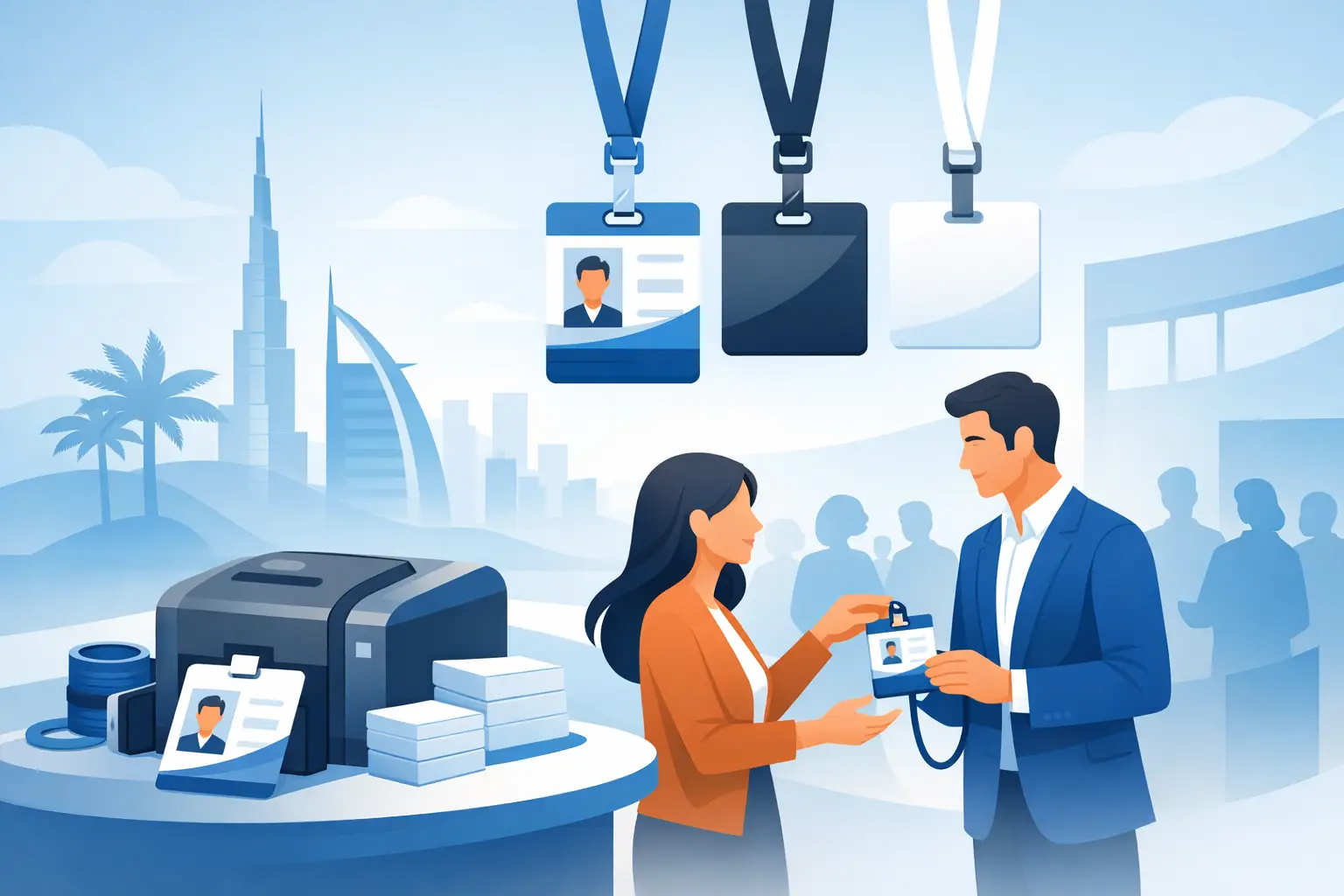
Event badge printing Dubai teams can trust - faster check-in, stronger branding, and reliable on-site delivery for conferences, launches, and expos.
A registration desk can look perfect on paper and still fail in the first ten minutes. The usual culprit is not the crowd. It is the badge workflow. When event badge printing Dubai projects are handled as a last-minute production task instead of a live operational system, lines build fast, staff start improvising, and the guest experience drops before the program even begins.
For agencies, brand teams, and event organizers in the UAE, badge printing is not just about putting a name on cardstock. It sits at the intersection of registration data, check-in speed, branding, access control, staffing, and on-site reliability. If any one of those pieces is weak, the badge becomes the first visible sign that the event is under pressure.
Why event badge printing in Dubai needs operational thinking
Dubai events move quickly, often with mixed audience types, multilingual guest lists, VIP layers, sponsor requirements, and tight venue access windows. A badge system that works for a small internal meeting will not hold up at a major conference, exhibition, or public-facing launch.
This is why event badge printing in Dubai has to be planned as part of the wider event tech stack. Your registration platform, approval flow, check-in process, badge design, printer setup, and staffing model need to work together. If they do, guests move through entry with confidence. If they do not, even a strong show build can feel disorganized at the door.
The trade-off is usually speed versus flexibility, but only if the setup is basic. A well-built system can deliver both. You can support pre-registered attendees, walk-ins, VIP guests, staff, media, and exhibitors without turning the welcome desk into a bottleneck. That requires the right software logic behind the print moment, not just a printer on a table.
What good badge printing actually solves
At surface level, a badge identifies a person. In practice, it does much more. It confirms registration status, supports wayfinding, reinforces brand presence, and helps staff manage access. At larger events, it can also connect to lead capture, session tracking, or sponsor activations.
That is why badge printing affects more than front-of-house efficiency. It shapes first impressions and downstream operations. A clean, fast badge process reduces queue anxiety and gives your team a stronger start. It also reduces manual corrections, duplicate records, and awkward guest interactions.
There is also a branding layer that matters. In premium environments, badges should feel considered, not generic. Stock templates and poorly aligned print layouts can undermine a polished event identity. On the other hand, fully custom designs are only useful if they print consistently at speed. Good execution sits in the middle - strong visual branding supported by formats and materials that perform well on site.
Choosing the right badge printing setup
Not every event needs the same production model. A leadership forum with a controlled guest list may benefit from pre-printed badges sorted by category or company. A fast-moving expo with rolling arrivals often needs on-demand printing tied to live check-in. A brand launch with influencers, partners, and VIPs may need a hybrid approach with some badges printed in advance and others produced live.
This is where many teams overcomplicate or oversimplify. Pre-printing everything sounds efficient until the attendee list changes the night before. Printing everything on demand sounds flexible until you underestimate peak arrival volume. The right answer depends on audience size, registration quality, venue layout, arrival patterns, and how much data validation needs to happen at the door.
A practical setup usually starts with three decisions. First, how many attendee types need distinct badge logic. Second, whether names are confirmed before arrival or need live verification. Third, what level of branding and access information must appear on the badge itself.
Once those decisions are clear, the print system can be built around the event rather than forced into a generic template.
Pre-printed badges
Pre-printed badges work well when guest data is stable and the arrival experience needs to be ultra-fast. They are useful for seated forums, private functions, award ceremonies, and VIP-heavy events where presentation matters and attendee changes are limited.
The risk is waste and version issues. Last-minute edits, no-shows, and unexpected replacements can create confusion unless there is a live print backup at the venue.
On-demand badge printing
On-demand printing is often the better fit for conferences, exhibitions, and public registration environments. It gives organizers flexibility, reduces waste, and supports real-time updates.
The pressure point is throughput. If the software, printer speed, label stock, and staffing plan are not aligned, the line will expose every weakness.
Hybrid models
Hybrid badge setups are often the most resilient. Core delegates or VIPs are printed in advance, while late additions, walk-ins, and changes are handled live. This gives the event a polished starting point without sacrificing flexibility.
The details that make or break check-in speed
Fast badge printing is rarely about the printer alone. It is about reducing the number of decisions that need to happen at the desk. If staff are searching records manually, correcting fields on the spot, or trying to interpret unclear registration statuses, print speed becomes irrelevant.
A better approach uses structured registration data, clear attendee categories, and check-in screens built for live environments. The ideal flow is simple. Find the guest, confirm the record, print instantly, and move them forward. The fewer exceptions, the faster the line.
Hardware placement matters too. Printers should be positioned for staff efficiency, with backup units ready for peak periods. Network dependencies should be tested under venue conditions, not assumed. Power, table layout, badge stock handling, and reprint logic all matter more than they seem during planning.
There is also a staffing reality. Even the best platform will struggle if the desk team has not been briefed properly. Badge printing should be supported by trained operators who understand both the technology and the guest journey. Live events reward preparation, not improvisation.
Branding without slowing down operations
Custom badges are often treated as a design exercise. They are also a live production asset. That means design choices should support readability, category recognition, and consistent output.
Overdesigned layouts can create printing issues, especially when variable data fields are long or multilingual. Dense graphics, weak contrast, or poor hierarchy may look good in a mockup and fail in a crowded registration hall. The best badge designs are brand-forward but operationally clear.
That usually means giving attendee names enough visual priority, making company or title data secondary, and using color or graphic treatment to distinguish groups quickly. If access zones or session permissions need to be visible, those should be obvious at a glance.
For experiential events, badges can also become part of the interaction. QR codes, RFID integration, or personalized visual treatments can support entry, engagement, or sponsor mechanics. But added functionality should earn its place. If it complicates printing without improving the event flow, it may not be worth it.
What agencies and organizers should expect from a badge partner
A badge printing vendor prints badges. A live event tech partner helps prevent front-of-house problems before they happen. That difference matters most when timelines are compressed or the event format is custom.
For event badge printing Dubai projects, the expectation should be more than equipment delivery. You need a partner who can connect registration logic with check-in hardware, adapt the print workflow to the venue, test the setup under live conditions, and support the desk once doors open.
That includes practical questions. How are no-shows handled. What happens if a printer fails. How quickly can layouts be revised. Can the system manage multiple attendee categories with different badge rules. Is there a fallback if connectivity drops. These are not edge cases. They are standard live-event considerations.
For agencies in particular, responsiveness matters. Creative direction often changes late, sponsor requirements shift, and guest lists evolve right up to show day. The right execution partner can absorb those changes without creating operational risk.
This is where a company like Eventro fits best - not as a standalone printer supplier, but as the technical layer that connects registration, check-in, on-site badge production, and branded guest experience into one working system.
The smartest badge setup is the one built for your event
There is no single best format for every conference, expo, launch, or activation. A smart badge solution is matched to audience behavior, venue conditions, branding priorities, and registration complexity. Sometimes that means premium pre-print packs. Sometimes it means high-speed live printing. Often, it means a hybrid model with backup logic already in place.
The real goal is not just to print badges. It is to keep the front door moving, protect the brand experience, and give your team control from the first guest arrival onward.
If you are planning an event in Dubai, treat badge printing like core event infrastructure, not an add-on. Guests notice the first touchpoint immediately, and once the line starts forming, every decision you made earlier becomes visible.